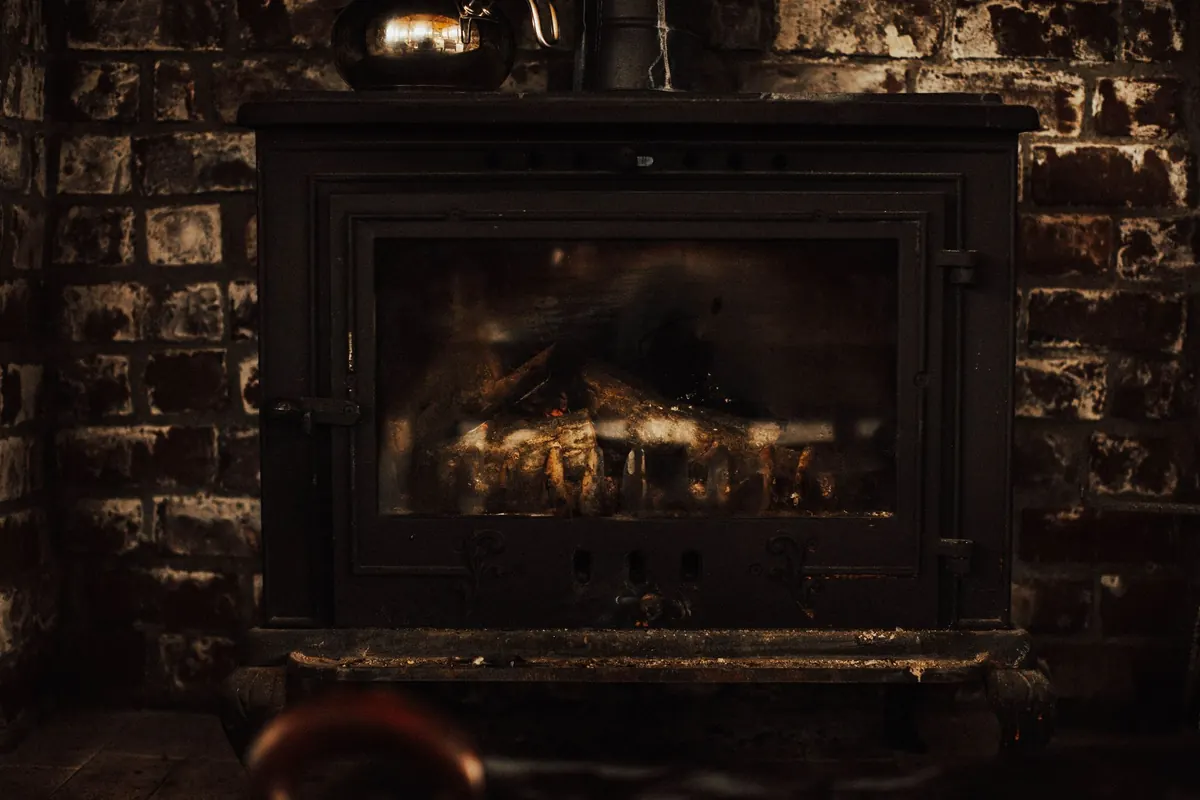
A wood stove is one of the few home improvements that earns its keep. It warms a room quickly, works when the power is out, and gives a kitchen or sitting room a natural focal point. It also has more rules attached to it than most people expect.
Fitting one looks simple enough: a metal box, a hole in the chimney, a length of flue pipe. The difference between a stove that burns cleanly for twenty years and one that smokes, drips tar or fails an inspection usually comes down to a handful of details decided long before anyone drills a hole. These are the mistakes that turn up again and again on UK installations.
Assuming the paperwork will sort itself out
Almost every solid fuel installation in the UK needs to comply with building regulations, and it needs to be notified. In England and Wales, Approved Document J is the reference point for combustion appliances; Scotland and Northern Ireland have their own equivalents. The rules differ in the detail, so check locally rather than assuming a neighbour's setup sets the standard.
There are two legitimate routes. You can use an installer registered under a competent person scheme, such as HETAS, who can self-certify the work and issue the compliance certificate. Or you notify your local building control team before work starts and have the installation inspected. What you cannot do is fit it yourself, quietly, and hope nobody asks. A missing certificate surfaces when you sell the house, when you claim on insurance after a chimney fire, and when a neighbour reports smoke.
One more thing worth checking early: many towns and cities are smoke control areas, where you may only burn authorised fuels or use an appliance exempted for that purpose. Councils publish maps, and it takes two minutes to check.
Getting the flue height and termination wrong
A flue works on the principle that warm gases rise and pull air in behind them. Get the height wrong and the whole system underperforms — often with smoke drifting into the room whenever the wind changes.
As a general rule, a flue needs to be around 4.5 metres from the appliance to the terminal. That is a minimum, not a target. A short flue on a single-storey extension, or one that only just clears the roof, rarely draws well.
Where the flue exits matters too. If the terminal sits within roughly 2.3 metres of a roof ridge, it should finish at least 600mm above that ridge. It also needs to clear opening windows, trickle vents and air bricks, and stay well away from boundaries where the plume could affect a neighbour. Cold external runs need an insulated twin-wall flue, otherwise the gases cool before they leave, condensate forms and the draw drops away.
Keep the route as straight as you can
Every bend adds resistance. One or two gentle offsets are usually fine; a flue that snakes around a lintel, a joist and a soil pipe is not. Where you do need a change of direction, use 45-degree bends rather than 90-degree ones and keep horizontal runs to an absolute minimum.
Ignoring ventilation and the air supply
A stove needs air — roughly the same volume it sends up the chimney, and then some. In older draughty houses the room often supplies it naturally. In anything built or refurbished in the last couple of decades, with sealed windows and draught-proofing, it rarely does.
An installer should calculate the permanent ventilation needed for the appliance's rated output and fit a vent sized accordingly. High-output stoves and open-flued appliances almost always need one. If a vent is fitted and you later block it because it feels cold, you have created a problem: the stove will pull air down the chimney instead, bringing smoke and carbon monoxide into the room.
Watch out for extractor fans in the same room, too. A powerful kitchen or bathroom fan can depressurise a space enough to reverse the flue. And fit a carbon monoxide alarm in the room as a matter of course — building regulations require one for solid fuel appliances, and it should meet BS EN 50291.
Treating hearth clearance as an afterthought
The hearth is not decoration. It exists to stop hot embers, spitting logs and radiant heat from reaching the floor and surrounding surfaces.
- For a closed appliance, the hearth typically extends at least 300mm in front of the stove and 150mm to each side. The manufacturer's instructions may ask for more.
- The base needs to be genuinely non-combustible and solid. A constructional hearth is usually at least 125mm thick; a thin slate tile laid over floorboards is not a hearth.
- Clearances to combustible walls, skirting, timber lintels and beams come from the appliance manual, not from what looks about right. Some stoves need only 100mm or so to a non-combustible wall but considerably more to a combustible one.
- Leave room for the door to swing, for loading logs and for emptying ash. A stove crammed into a recess is awkward to live with and harder to keep clean.
Manufacturer's instructions take precedence over generic figures, and building control will check them. Keep the manual — you will need it.
Buying a stove that is too big
A stove running flat out in a room it can barely heat is efficient. A large stove throttled right down in a small room is not. It smoulders, produces tar and creosote, blackens the glass, wastes fuel and increases the risk of a chimney fire.
As a rough starting point, many installers work on around 1kW of output per 14 cubic metres of reasonably insulated room. That is only a starting point. Ceiling height, glazing, insulation and how the room connects to the rest of the house all shift the number. If you are between two sizes, the smaller one is usually the safer choice — and it costs less to run.
Cutting corners on the liner and connections
An old chimney that has never carried a modern stove is not automatically ready for one. It may be leaking, undersized, or lined with something unsuitable. A stainless steel flexible liner, correctly specified, protects the chimney and gives you a predictable, easy-to-sweep flue.
Two details matter more than people realise. First, the grade: 316-grade liner suits wood; multi-fuel and smokeless coal generally call for 904-grade. Second, the orientation: the smoother surface should face the flue gases so soot and condensate do not catch on the corrugations. Fit it the wrong way round and the flue will clog faster.
Then there are the small boring bits. The register plate or closure plate must seal properly, with no gaps for smoke to escape into a loft. The connection to the stove collar must be tight. The chimney should be swept and smoke-tested before lining. And burn dry wood — kiln-dried logs or fuel marked Ready to Burn, with a moisture content under 20 per cent. Wet wood is the single biggest cause of tarred-up flues.
Before you book an installer: a five-point check
- Check whether you are in a smoke control area, and whether the stove you want is exempt for use there.
- Confirm your installer is registered under a competent person scheme, or notify building control in advance.
- Ask for the ventilation calculation in writing, along with the flue height and termination heights they plan to use.
- Measure your hearth and clearances against the manual before ordering, not after delivery.
- Budget for the flue, the liner and the labour before the stove itself. The appliance is the visible part; the flue is what makes it work.
If anything about the rules or the compliance certificate is unclear, speak to your local building control team or a registered installer before work begins. It is a short conversation that prevents an expensive one later.
Done properly, a wood stove is a low-maintenance, decades-long fixture. Done in a hurry, it is a source of smoke, smell and paperwork you would rather not deal with. Spend the time on the flue and the installation, and the stove will quietly get on with its job.
Photo: Lokman Sevim / Pexels